Why does my drain keep clogging after cleaning
Your drain keeps clogging after cleaning because the real blockage was never removed. Here is what is actually happening in New Braunfels homes and how to fix it.
Your drain keeps clogging after cleaning because the cleaning only punched a hole through the blockage instead of removing it. A cable or store-bought chemical clears the center of the pipe, water flows again for a few days, and the same grease, soap scum, or root mass closes back over the opening. That is why a drain that was snaked on Monday is backing up again by Friday.
This article explains the real reasons drains re-clog in New Braunfels, what our technicians find when we open a line that has been "cleared" three or four times, and how to fix the problem for good. If you have already paid for a cleaning that did not stick, you are in the right place.
The short answer: the clog was never fully removed
A recurring drain clog in New Braunfels TX is a blockage that reforms because the underlying buildup, pipe damage, or root intrusion was never addressed. Most drain cleaning tools remove the center of the clog and leave the walls of the pipe coated. Water flows, but the pipe is still 60 to 80 percent restricted.
Think of it like a highway with one lane open. Traffic moves. Then a single stalled car shuts the whole thing down again. That is what happens every time you run the disposal, take a shower, or do a load of laundry.
Three things cause this pattern:
- Partial removal. The tool cleared a channel, not the pipe.
- Recurring source. Roots, grease, or scale keep coming back.
- Pipe condition. Bellied, offset, or cracked pipe catches debris every time.
Until you identify which one you are dealing with, every cleaning is a temporary fix. Homeowners across plumbing New Braunfels TX call us for this exact problem, and the diagnosis is almost always one of those three.
Why does my drain keep clogging after cleaning in New Braunfels?
Drains in New Braunfels re-clog faster than in many parts of Texas because of our water chemistry, soil, and the age of the housing stock. The average home here sits on limestone-heavy ground with hard water running through pipes that were sized for a smaller household.
Hard water scale builds a rough surface inside the pipe
New Braunfels water runs roughly 12 to 18 grains per gallon of hardness. That calcium and magnesium leaves scale on the inside of drain pipes the same way it crusts a showerhead. Scale is rough. Rough surfaces grab grease, hair, and soap. Once the pipe is coated, a cleaning only buys you a few weeks.
Tree roots find the smallest crack
Live oaks, pecans, and crape myrtles send roots toward moisture. A hairline crack or a loose joint in a clay or cast iron sewer line is an open invitation. Roots enter as thin threads and grow into a mat. A cable cuts the mat, but the roots are still there. They regrow in 60 to 90 days.
Older pipes in older neighborhoods
Homes built before 1980 in areas like the streets around Landa Park and downtown often still have cast iron or Orangeburg sewer lines. Cast iron pits and roughs up. Orangeburg collapses. Either way, debris snags every time water passes.
Low-flow fixtures and less water
Modern 1.28-gallon toilets and 1.8-gallon-per-minute showerheads use less water than the pipes were designed for. Less volume means less scouring. Waste sits longer and sticks harder.
Hard water, caliche soil, and the New Braunfels factor
New Braunfels sits on the Edwards Aquifer recharge zone, and the water that comes out of the tap is mineral-heavy. That is great for taste and terrible for drain lines. The same calcium that makes Hill Country water famous is what coats the inside of your kitchen and bathroom drains.
Caliche soil is the other half of the problem. It is dense, alkaline, and shifts with our wet-dry cycles. When the ground moves, sewer lines move with it. Joints separate. Pipes bellies. Roots slip in through the gaps.
We see this most in homes between 15 and 45 years old. The pipe is not failed, but it is no longer straight or sealed. A camera inspection usually shows the exact spot where debris is catching. If you have had the same line cleared three or more times, a sewer line services New Braunfels TX inspection is the next step, not another cable.
What a store-bought cleaner actually does to your pipes
Drain cleaner from the hardware store is a caustic or acid product designed to dissolve organic matter. It works on hair and soap in a slow-moving bathroom sink. It does not work on grease, roots, or scale, and it does real damage over time.
Here is what repeated chemical use does:
- Heat-cracks PVC and ABS pipe at the joints
- Accelerates corrosion in cast iron and galvanized steel
- Hardens grease into a wax-like plug downstream
- Creates a splash hazard for anyone who opens the trap later
If you have poured a bottle down the drain three or four times and it keeps backing up, stop. The chemical is not reaching the clog. It is sitting on top of it and eating your pipe instead.
Common mistakes that make recurring clogs worse
Most repeat clogs we get called out for are made worse by something the homeowner did between visits. None of these are stupid mistakes. They are the things nobody tells you.
- Snaking the same line over and over. A cable cuts a channel. It does not restore pipe diameter. After three or four passes, you have spent more than a proper cleaning would have cost.
- Using a plunger on a chemical-filled drain. If you poured cleaner and it did not work, plunging can splash caustic liquid back at you.
- Flushing wipes, "flushable" or not. They do not break down. They catch on scale and roots and form the core of the next clog.
- Pouring grease down the kitchen sink. Even with hot water, grease cools in the pipe. It coats the walls and grabs everything behind it.
- Ignoring a slow drain. A drain that takes 30 seconds longer to empty is already 50 percent blocked. Fix it before it stops.
If your kitchen line is the repeat offender, the problem is often the disposal and the way it is being used. We handle a lot of garbage disposal repair New Braunfels TX calls that start as "my sink keeps backing up."
How to stop a drain from clogging again
Stopping a recurring drain clog in New Braunfels TX means fixing the source, not just the symptom. That starts with finding out what is actually in the pipe.
Step 1: Camera the line
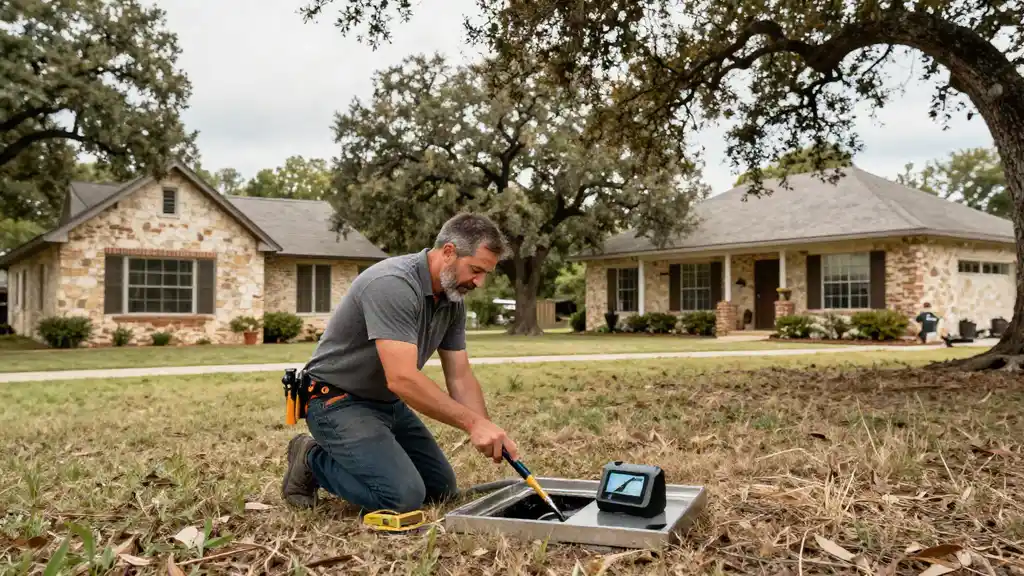
A sewer camera shows scale, roots, bellies, offsets, and cracks. It takes 20 to 30 minutes and tells you whether you need cleaning, repair, or replacement. Without it, you are guessing.
Step 2: Hydro-jet instead of cable
Hydro-jetting uses 3,000 to 4,000 PSI of water to scour the full inside diameter of the pipe. It removes scale, grease, and root mass instead of punching a hole. For a kitchen line, this is the difference between a two-week fix and a two-year fix.
Step 3: Fix the pipe if it is damaged
If the camera shows a crack, offset joint, or root intrusion at a specific point, cleaning alone will not hold. A spot repair or a section replacement is the permanent answer. Trenchless options let us do this without tearing up your yard or driveway.
Step 4: Treat the water
If scale is the recurring problem, a water softener removes the calcium before it ever reaches your drains. It also extends the life of your water heater and fixtures. We install water softener installation New Braunfels TX for homeowners who are tired of replacing fixtures every few years.
Step 5: Change a few habits
- Run cold water for 15 seconds before and 30 seconds after using the disposal
- Never pour grease, oil, or coffee grounds down the sink
- Use a hair catcher in every tub and shower
- Flush the line with a full tub of hot water once a month
When to call a professional
Call a professional when the same drain has clogged twice in 90 days, when multiple fixtures are slow at the same time, or when you hear gurgling from a tub while running the washing machine. Those are signs the blockage is in the main line, not a single fixture.
At Comal Crest Plumbing, we run a camera first, show you what is in the pipe, and tell you whether you need a cleaning, a repair, or a replacement. No guesswork, no repeat visits for the same problem. We work on homes and businesses across Comal County, and we see the same patterns in the same neighborhoods every week.
If you are dealing with a recurring drain clog and want it diagnosed correctly the first time, our team handles drain cleaning New Braunfels TX with camera verification on every job. We also serve commercial kitchens and offices that cannot afford a shutdown, which is why we offer commercial plumbing New Braunfels TX with after-hours scheduling.
Frequently Asked Questions
Why does my drain keep clogging after cleaning in New Braunfels?
Because the cleaning removed the center of the clog, not the buildup on the pipe walls. Hard water scale, grease, and roots regrow in 30 to 90 days. A camera inspection finds the real cause.
How do I stop my drain from clogging in Texas?
Keep grease, wipes, and hair out of the line, run plenty of water with every use, and address hard water scale with a softener. If the same drain clogs twice in 90 days, get the line camera-inspected.
Do I need professional drain cleaning in New Braunfels TX?
Yes, if the drain has clogged more than once in three months, if multiple fixtures are slow, or if you hear gurgling. Store-bought cleaners do not fix recurring clogs and can damage older pipes.
What causes recurring drain clogs near me?
In New Braunfels, the top causes are hard water scale, tree root intrusion at cracked joints, and cast iron or Orangeburg pipe that has roughed up or bellied. Each one needs a different fix.
How much does drain cleaning cost in New Braunfels in 2026?
Typical 2026 pricing runs $150 to $350 for a standard fixture line and $300 to $600 for a main line with hydro-jetting. Camera inspections usually add $150 to $300, and we credit that toward the repair when you move forward.
Get help with plumbing in New Braunfels
If your drain keeps clogging after cleaning, the fix is a proper diagnosis, not another bottle of chemicals. Call Comal Crest Plumbing at (737) 707-1110 and we will camera the line, show you what is wrong, and give you a straight answer on what it takes to fix it for good.