Common plumbing problems in Gruene historic homes
Galvanized supply lines, clay sewer laterals, and 40-gallon water heaters are behind most plumbing problems in Gruene historic homes in New Braunfels TX. Here's what fails and why.
The most common plumbing problems in Gruene historic homes in New Braunfels TX are galvanized steel supply pipes that have rusted shut, clay or cast iron sewer laterals cracked by tree roots, and water heaters that were sized for a 1940s household of four and now serve a family of six with a hot tub. Those three failures account for the majority of the calls we run in the Gruene historic district, and each one has a different fix and a different price tag.
Below we break down what actually fails in these houses, how to tell which problem you have, and what the repair looks like in 2026.
Why Gruene's historic homes have plumbing problems other New Braunfels houses don't
Gruene's historic homes have plumbing problems other New Braunfels houses don't because most of the district was built between roughly 1900 and 1940, decades before copper, PEX, and PVC became standard. The original plumbing in these houses was galvanized steel for supply and clay tile or cast iron for waste, and both materials have a service life of about 40 to 70 years. That clock ran out a long time ago.
The other factor is the lots themselves. Gruene sits on the north bank of the Guadalupe River, and the soil under these properties is a mix of river loam and caliche that shifts with every wet-dry cycle. That movement is hard on rigid pipe. A cast iron drain line that was fine in 1955 can crack at a joint after a decade of soil expansion, and you won't know until water starts pooling at the base of a toilet.
Add the fact that many of these houses have been added onto two or three times over the decades, and you end up with a plumbing system that's part 1930s galvanized, part 1970s copper, and part 2000s PEX - all tied together with fittings that were never designed to meet. When we open a wall in a Gruene house, we expect to find three eras of plumbing in the same cavity.
Galvanized steel supply pipes: the number one problem in Gruene
Galvanized steel supply pipes are the single biggest issue we see in Gruene historic homes, and the symptoms are consistent enough that we can usually diagnose them over the phone. Galvanized pipe is steel coated in zinc to resist corrosion. The zinc wears away from the inside out, and once it's gone, the steel rusts, flakes, and closes off the pipe from the inside.
Here's what that looks like in a real house:
- Water pressure drops noticeably at fixtures farthest from the meter - usually the second bathroom or the kitchen sink.
- Water comes out brown or rust-colored first thing in the morning, then clears after a minute.
- You hear a banging or hammering sound when you shut off a faucet.
- Fixtures share pressure - running the shower drops the kitchen sink to a trickle.
- You get pinhole leaks at joints, often two or three in the same year.
Once a galvanized system reaches this stage, patching individual leaks is throwing money at a losing battle. The pipe is failing everywhere, not just where it's leaking. The right fix is usually a whole-home repipe - pulling the old steel out and running new PEX or copper through the same chases. For most Gruene homes in the 1,200 to 2,000 square foot range, that's a two to four day job.
If you're seeing brown water and dropping pressure, our team handles repiping New Braunfels TX homes on a regular basis, including the older housing stock around Gruene and the Comal River.
What a repipe actually involves
We map the existing runs, cut access points in the walls and ceilings, pull the old galvanized out, and run new PEX-A or copper through the same paths. We pressure-test the new system at 100 PSI for at least an hour before we close anything up. Then we patch the drywall and you're back to normal water pressure the same week.
Typical 2026 pricing in the New Braunfels area for a full repipe on a 1,500 square foot historic home runs $4,500 to $9,000 depending on access, fixture count, and how much of the old pipe is buried in plaster versus drywall. Plaster walls add labor because they're harder to open and patch cleanly.
Clay and cast iron sewer lines under Gruene's old lots
Clay and cast iron sewer lines under Gruene's old lots are the second most common failure we deal with, and they're the most expensive to ignore. The original sewer laterals in this district were vitrified clay tile - short two-foot sections joined with mortar. Those joints are the weak point. Roots find them, work their way in, and widen the gap season after season.
Cast iron has its own problem. It rusts from the inside, and after 60 or 70 years the bottom of the pipe is often gone, leaving a channel that catches everything. You'll get repeated backups at the lowest fixture in the house - usually a downstairs toilet or a floor drain - no matter how many times you snake it.
Signs your sewer lateral is failing:
- Multiple drains backing up at once, not just one.
- Gurgling sounds from the toilet when you run the washing machine.
- Sewage smell in the yard or around the foundation.
- Slow drains throughout the house that snaking doesn't fix.
- Patches of unusually green, fast-growing grass in the yard.
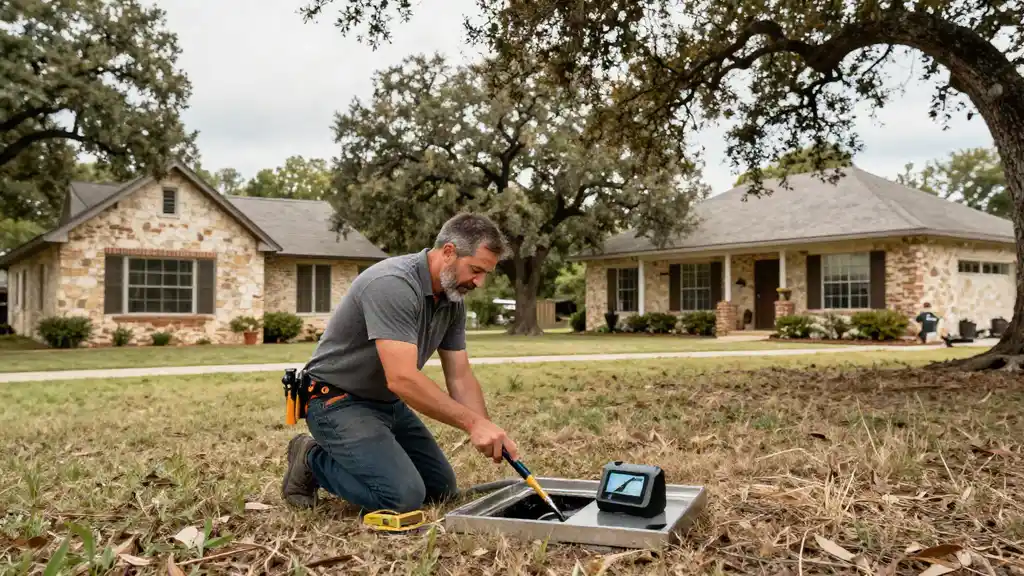
We run a camera down the line before we recommend anything. If the pipe is intact and the problem is roots or grease, sewer line services New Braunfels TX like hydro-jetting will clear it and buy you years. If the pipe is collapsed or has offset joints, we're looking at repair or replacement.
Trenchless sewer line replacement is the standard approach now for most Gruene properties, because it avoids tearing up mature landscaping and the historic brick walkways that a lot of these homes have. We pull a new HDPE liner through the existing pipe path from two small access pits instead of digging a trench the length of the yard.
Water heaters that were never sized for a modern household
Water heaters in Gruene historic homes were never sized for a modern household, and that mismatch shows up as cold showers by the third person every morning. A 40-gallon tank was plenty for a family of four in 1960. It is not enough for a family of four in 2026 with a soaking tub, a dishwasher that runs twice a day, and a teenager who takes 20-minute showers.
There's also a venting problem specific to these houses. Older homes were built with atmospheric-vent water heaters that draft through a masonry chimney or a single-wall flue. When we replace a tank, we have to confirm the flue is actually drafting - a blocked or undersized chimney will spill carbon monoxide into the house. We test draft with a smoke pencil before we sign off on any tank swap in a historic home.
Two paths make sense for most Gruene homeowners:
- Bigger tank, same location. A 50 or 75-gallon tank in the existing closet. Simple, cheap, and it works if you have the space and the flue is sound. Expect $1,800 to $3,200 installed in 2026.
- Tankless. A condensing tankless unit frees up the closet, gives you endless hot water, and vents horizontally through a PVC pipe - which sidesteps the chimney problem entirely. Installed cost runs $3,500 to $6,500 depending on gas line size and venting run.
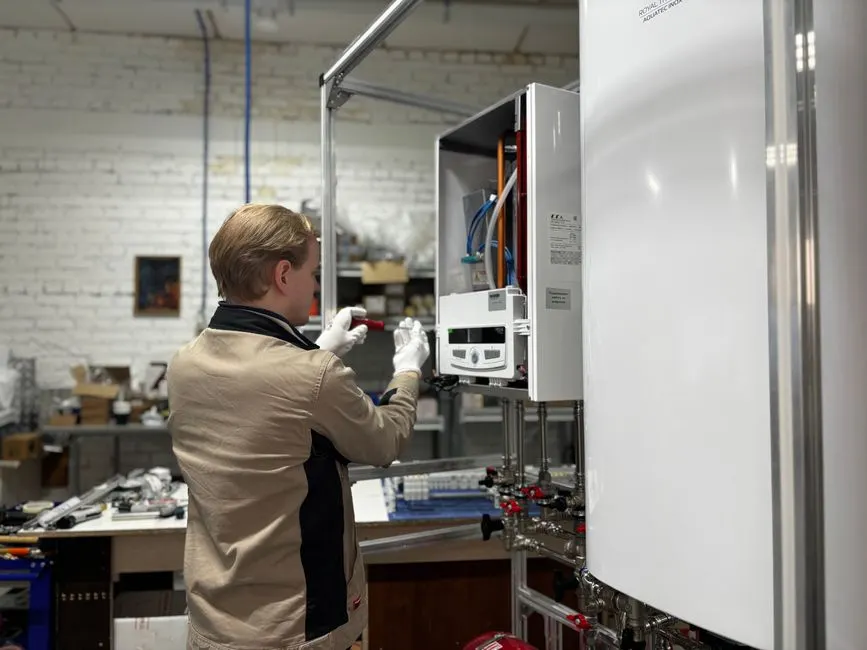
If your current tank is over 10 years old and you're already running out of hot water, replacing it before it fails is cheaper than an emergency swap on a Sunday. We handle water heater installation New Braunfels TX for both tank and tankless setups, and we'll tell you straight which one fits your house.
Drain clogs caused by old pipe diameter and root intrusion
Drain clogs in Gruene historic homes come from two things modern houses don't have: undersized pipe and root intrusion. Older drain lines were often run at 1.25 or 1.5 inches for sinks and tubs, where today's code calls for 2 inches minimum. That smaller diameter means grease, soap scum, and hair build up faster and clog sooner.
Root intrusion is the other half. Even a sewer line in good condition will have roots at the joints if there's a mature pecan or oak within 10 feet of the run. Pecans are the worst offenders in this part of Comal County - their roots travel far and they're aggressive about finding moisture.
What actually works, in order:
- Hydro-jetting for grease and scale. A high-pressure jet scours the pipe wall instead of just poking a hole through the clog.
- Camera inspection to find out whether the clog is a one-time event or a symptom of a broken pipe.
- Root cutting with a chain cutter if roots are the issue, followed by a foaming root killer twice a year.
- Pipe replacement if the camera shows cracked, offset, or collapsed sections.
If you're dealing with a recurring clog, our drain cleaning New Braunfels TX service starts with a camera so we know what we're actually clearing before we run a jetter through it.
What are the signs your Gruene home needs a repipe?
Signs your Gruene home needs a repipe come down to three things: consistent brown water, dropping pressure at every fixture, and leaks that keep appearing in different spots. Any one of those on its own might be a single repair. All three together on galvanized pipe means the system is done.
Here's the test we use. Turn on the cold water at the kitchen sink and the shower at the same time. If the kitchen sink drops to a trickle, the pipe is choked with rust and scale. If the water runs brown for more than 30 seconds after sitting overnight, the interior of the pipe is actively corroding.
One more thing to check: look at the exposed pipe in the garage or under the house. Galvanized pipe that's failing will show rust-colored staining at the joints and a chalky white or gray crust on the outside. If you see that, you're on borrowed time.
What to watch out for when updating plumbing in an old Gruene house
Updating plumbing in an old Gruene house comes with three traps that catch homeowners who hire the wrong crew. The first is assuming the walls are drywall. A lot of these houses have plaster and lath, which is harder to open, harder to patch, and hides knob-and-tube wiring and old gas lines you don't want to hit with a sawzall.
The second trap is skipping the sewer camera. If you repipe the supply side and don't look at the drain side, you'll spend $7,000 on new supply lines and then discover the sewer lateral is collapsed. Do both inspections at the same time.
The third is assuming the water heater closet can take a bigger tank. In a historic home, that closet was sized for a specific unit. A 75-gallon tank may not physically fit, and the flue may not handle the extra BTU load. Measure first, then decide.
A few more things worth knowing before you start:
- If your home is in the Gruene Historic District, exterior work may need review. Interior plumbing work generally does not, but confirm before you plan anything that touches the outside of the house.
- New Braunfels water runs hard - 12 to 18 grains per gallon in most of the city. A water softener will roughly double the life of a new tank water heater and keep fixtures from scaling up.
- Permits are required for water heater replacements and sewer line work in Comal County. We pull them.
When to call a professional
Call a professional when you see brown water at more than one fixture, when a drain backs up twice in the same month, or when you find water where it shouldn't be. Those three symptoms point to system-level problems that a plunger and a bottle of drain cleaner won't fix - and drain cleaner can actually make galvanized and cast iron worse by accelerating corrosion.
At Comal Crest Plumbing, we work on Gruene's historic housing stock regularly. We know what's behind the plaster, we know where the old clay laterals run, and we know how to fix the problem without tearing your house apart. If you're not sure whether you're looking at a $200 repair or a $7,000 repipe, we'll come out, run a camera, and tell you exactly what's going on.
If you're in the Gruene area and need a second opinion on any of this, our plumbing New Braunfels TX team handles everything from single-fixture repairs to full repipes on historic homes.
Frequently Asked Questions
What are common plumbing problems in Gruene historic homes?
Galvanized steel supply pipes that have rusted shut, clay or cast iron sewer laterals cracked by roots, undersized water heaters, and recurring drain clogs from small-diameter pipe. Most Gruene homes built between 1900 and 1940 have at least two of these four issues.
How do I update plumbing in an old Gruene house in Texas?
Start with a camera inspection of the sewer lateral and a pressure test on the supply lines. If the supply is galvanized and failing, a full repipe with PEX or copper takes two to four days. If the sewer is clay or cast iron, trenchless replacement is usually the right call. Typical 2026 cost for both runs $8,000 to $16,000.
Who repairs historic home plumbing in Gruene New Braunfels TX?
You want a licensed plumbing contractor who works on older housing stock regularly - someone who knows plaster walls, galvanized pipe, and clay laterals. Comal Crest Plumbing handles historic home plumbing repair across Gruene and the surrounding New Braunfels area.
Is galvanized plumbing bad in old homes near me?
Yes, once it's past 50 years old. Galvanized pipe rusts from the inside, restricts flow, and starts leaking at joints. It's not a question of if it fails, but when. If your Gruene home still has galvanized supply lines, plan on a repipe.
How long does a repipe take on a historic Gruene home?
Two to four days for a typical 1,200 to 2,000 square foot house, plus a day for drywall patching. Plaster walls add a day. We pressure-test at 100 PSI before closing anything up, so you have water back the same week.
Get help with plumbing in New Braunfels
If your Gruene home is showing any of the symptoms above - brown water, dropping pressure, recurring backups, or a water heater that can't keep up - we can diagnose it and give you a straight answer on what it takes to fix.
Call Comal Crest Plumbing at (737) 707-1110 to schedule a visit. We work on historic homes across Gruene and New Braunfels, and we'll tell you what's actually wrong before we quote a repair.